How SASE benefits the network edge—and MSPs can help SMBs deploy it
Many smaller business struggle to provide robust, secure connectivity at the network’s edge. New technologies such as SASE provide a more unified, secure approach to networking security than a traditional VPN.

Key takeaways from this article on SASE benefits:
- With today’s workforces becoming more distributed, companies need to be able to secure data and applications at the network’s “edge” without sacrificing performance.
- SASE, or secure access service edge, enables companies to unify security and networking at the edge at lower cost and with greater management simplicity.
- Managed service providers are well positioned to help smaller companies gain SASE benefits and reduce cost, boost network security, and reduce latency,
Distributed workforces create networking security gaps
Over the past several years, company operations have shifted dramatically. Economic uncertainty, supply-and-demand shocks, and shifts in the labor force have placed new pressures on companies trying to deliver more efficiently and cost-effectively.
Distributed workforces are central to this new economic landscape—whether employees are in branch offices, in the field, at a home office, or at an airport. Given increasingly dispersed workers, organizations need to provide flexible, secure, and seamless connectivity to applications and data.
But the truth is, distributed work brings connectivity issues and security vulnerabilities. Users at the airport, in coffee shops, or in the field often experience laggy connections and security gaps when they access data at the network’s edge. This “edge” is increasingly where data is being processed: on tablets, phones, IoT, and other devices to accommodate users on the go.
Enabling the edge edge brings connectivity closer to the devices and users that need it—but opens up security vulnerabilities and performance problems. SASE—or secure access service edge—is designed to secure these connections— without incurring application performance lags or data breaches.
Network connectivity and security struggles at the edge are particularly salient for small and midsize businesses. Compromised network edge devices accounted for initial compromise in 30% of incidents affecting SMBs in 2024. Network edge devices may not support security tools, which makes them a target for malicious activity. But SASE can address some of these security gaps. SASE’s cloud-based architecture offers unified security for both on-site and remote employees—potentially more cost-effectively for SMBs.
For years, SMBs’ answer to secure network connectivity was virtual private networks (VPNs) for network connectivity. By encrypting traffic between a user’s device and internal networks, VPNs provided another layer of security. But VPNs were built for an IT landscape with fewer dispersed workers who are mainly accessing on-premises resources, not cloud-based applications.
With cloud computing becoming pervasive and more distributed teams, VPNs may no longer be the best choice for SMBs seeking secure, anywhere anytime access for users. VPNs bring connectivity and performance bottlenecks, and they create security vulnerabilities if they aren’t properly patched and update. They also don’t support a zero-trust architecture, which is key for modern cloud security.
As organizations move to cloud architecture result, some SMBs are considering alternatives to VPNs, such as SASE to secure users and devices at the edge while boosting connectivity and performance.
“SMBs that are moving away from traditional firewalls. Some organization might not even have them and use WeWork space instead. But they still need secure, reliable connectivity, and that’s where SASE can come in,” said Adel Strauss, vice president of product and portfolio, at Integris
In what follows, we look at how SASE can help smaller organizations—and how managed service providers (MSPs) are perfect candidates to help these SMBs manage SASE.
What is SASE, and what are key SASE benefits?
Secure access service edge (SASE) enables secure access as applications, devices, and users become more distributed. It addresses the limitations of traditional security models by converging networking and security functions into a single, cloud-delivered service. SASE also provides consistent, secure access to resources regardless of user location or device, while also simplifying IT infrastruture and reducing costs.
Organizations are taking note of the benefits of secure access service edge. Dell’Oro Group, a market research firm, forecasts that the SASE market will triple by 2026, topping $13 billion.
Organizations are increasingly considering SASE for its ability to mitigate threats in real time, enforce dynamic access policies, and scale without the constraints of physical infrastructure.
Now, let’s explore the core benefits that SASE promises:
Eliminates the need for traditional firewalls and subsequent management. With SASE, organizations have network and security unified and “as a service,” so they no longer have to manage and monitor individual firewalls and update each one. With SASE, an organization can protect the data and applications.
Reduced latency and improved user experience. SASE architecture minimizes latency by delivering security services closer to users and applications, especially for remote users and branch offices, enabling faster access to resources. According to the “2025 State of Network Access Report,” 49% say that SASE improves application performance and bandwidth optimization.
Improved network security. SASE uses a zero-trust model, whereby access to resources is granted only after verifying a user or device’s identity and context. Zero trust can significantly reduce the attack surface. According to Comcast data, nearly 70% of respondents experienced improved security after implementing SASE.
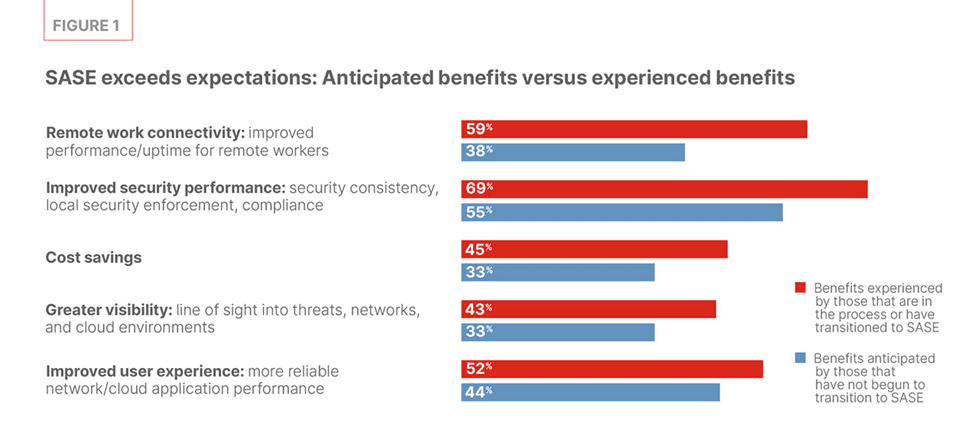
Source: Comcast Business, “2022 SASE Market Trends Study,” 2022.
Reduced cost. SASE solutions can eliminate the need for companies to spend dollars on capital expenditures by buying costly on-premises hardware, reducing upfront investments in security and networking equipment. According to the “2025 State of Network Access Report,” 46% of respondents say that SASE reduces costs through consolidation of tools and services.
Unified network management. According to the “2025 State of Network Access Report,” 52% of respondents say that SASE brings simplified, centralized networking and security management—clear wins at the edge.
In sum, secure, cost-effective, and unified management makes SASE a key network security solution for SMBs.
“With a cloud-based solution, like SASE, MSPs can better protect users no matter where they work—without sacrificing application performance or ease of use,” Strauss said.
At the same time, companies’ adoption of SASE remains incremental. Only 8% of organizations have fully implemented SASE solutions, according to the “2025 State of Network Access Report.” Adoption is growing, however, with 32% currently in progress and 24% planning implementation in the next 12 months.
Ensuring secure, reliable connectivity for the myriad devices at the edge—tablets, IoT devices, and more—will be key to Industry 4.0.
How an MSP can implement the right SASE solution
According to the “2025 State of Network Access Report,” 48% of respondents say that SASE integration with other systems and IT infrastructure can be challenging. That is an argument for expert help as you deploy the solution. In the same study, 37% of respondents say that they lack the in-house expertise to implement SASE. Further, 44% say that instituting policy management is challenging. According to the same report, a combined 78% of respondents use MSPs to co-manage or fully manage their SASE architecture. From choosing a SASE vendor to implementing and managing the solution, MSPs can be critical to SASE success.
With the right MSP partner, companies can consolidate tools and simplify infrastructure so they can reduce costs and ease management overhead. Further, an MSP can help integrate SASE without introducing new security gaps.
“The right MSP can speed the process of implementing SASE and create an organized, prioritized rollout so that users can get secure, reliable connectivity without a patchwork of solutions,” Strauss said.
To explore Integris cloud services, click here.