How to build KPIs for your compliance as a service program
Build a smarter, scalable compliance program with KPIs that turn real‑time visibility into measurable, business‑driving results.

Key takeaways:
- Strong compliance key performance indicators (KPIs) help organizations shift from reactive compliance to continuous, measurable performance management, creating visibility, demonstrating progress, and driving improvement.
- Effective compliance as a service (CaaS) KPIs fall into three categories—control/framework maturity, operational security performance, and business readiness—each showing how well foundational controls, security operations, and business outcomes are progressing.
- A mature, MSP-supported CaaS program enables automated evidence collection, disciplined operational execution, and executive-ready reporting, making KPI achievement both scalable and sustainable.
Is your compliance program data ready?
Modern compliance has outgrown the days of spreadsheets and frantic audit prep. AI technology has changed the game for everything from data governance to cybersecurity to backup/disaster recovery, employee security awareness training, and more. This has raised the stakes for compliance, and many organizations have become willing to invest in managed service provider (MSP) contracts to create a cohesive compliance as a service (CaaS) program at their company.
That kind of investment usually means one thing: key performance indicators (KPIs)—and the ability to track whether the spending is worth it. Performance monitoring may seem like a tricky goal with a process as multilateral as compliance. But thanks to AI and a raft of new compliance and cybersecurity tools, there are many levers to pull to create solid, trackable metrics for your compliance as a service provider.
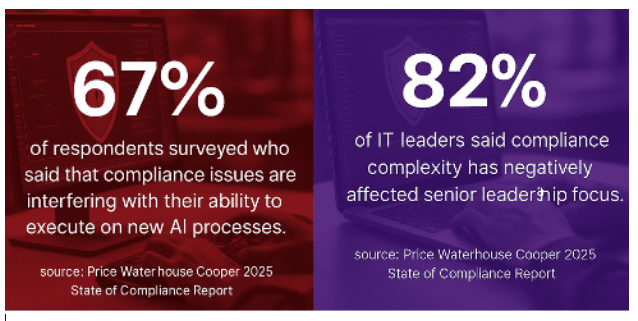
As an MSP working with small and midsize businesses across the nation, Integris works with clients to establish compliance KPIs regularly. We understand how to reduce your compliance reporting burden. Let’s dig into the anatomy of compliance KPIs, and why they matter for SMBs.
What is a ‘good’ compliance KPI?
Without solid metrics, it’s impossible to know whether your program is improving or quietly deteriorating. A mature CaaS model will help centralize compliance operations, and create a repeatable, well-governed workflow with continuously monitored KPIs.
Strong KPIs help you do the following:
- create visibility into control performance
- demonstrate progress to auditors, regulators, insurers, and executives
- quantify consistency in policy adherence, control execution, and translate risk into business impact
- fuel continuous improvement with clear direction
In short, KPIs transform compliance from something you react to into something you manage in real time, every day.
The six traits of good compliance KPIs
Not all KPIs are created equal. Some are “vanity” metrics (or superficial data points that measure little progress), while others measure activity rather than outcomes. A compliance as a service provider should focus on KPIs that truly move the needle.
Good compliance KPIs have this in common:
- Tied to a specific control or obligation. They map to general frameworks like those from NIST CSF 2.0 or industry-driven compliance structures such as CMMC (Cybersecurity Maturity Model Certification) for manufacturing or HIPAA (cybersecurity controls for the Health Insurance Portability and Accountability Act) for healthcare.
- Objective and measurable. They have no ambiguity and definitions are precise.
- Continuously trackable. They report into a dashboard continuously, not just before an audit.
- Comparable over time. Data created makes it possible to identify trends that reveal strengths and weaknesses.
- Actionable and business relevant. They show understandable return on investment (ROI) for your C-suite to determine success/failure, and areas to be addressed.
- Balanced across the lifecycle. They measure operational discipline and business readiness.
Understanding the types of compliance KPIs
Thankfully, a CaaS program can have different kinds of KPI controls, and there’s lots to choose from. For the sake of this article, we’ll break KPIs into three types: control and framework maturity, operational security performance, and business readiness/compliance outcomes. These categories mirror how compliance matures over time–from foundational controls to operational execution to strategic business impact.
First, let’s dig into control and framework maturity KPIs.
Types of control and framework maturity KPIs
Control/framework KPIs validate the foundation of a compliance program and ensure that policies and controls align with frameworks. The mature CaaS model keeps policies current, proactively maintains documentation, and continuously collects evidence. Together, these KPIs answer the questions “Do we have the right controls, and are they functioning consistently?”
Key KPIs include the following:
- Framework control coverage. The percentage of controls implemented against specific compliance frameworks such as CIS v8 (Center for Internet Security Controls version 8) or NIST 800171 (National Institute of Standards and Technology.) The higher the coverage, the higher your organization’s maturity.
- Critical asset protection coverage. The share of endpoints, identities, email, and cloud apps protected by managed security controls (such as ,).
- Multifactor authentication and conditional access coverage. This KPI measures the number of systems with conditional access and the level of permissioning throughout.
- Backup and recovery test pass rate. Backups mean nothing if they can’t be restored. This KPI proves resilience.
- Policy acknowledgement of completion. This measurement tracks employee compliance against required policies like AI acceptable use, bring your own device, and more.
- Privileged account review closure. This tracking mechanism shows how quickly you identify and close privileged access risks.
Operational security performance KPIs
This type of KPI measures how effectively organizational systems detect, respond to, and reduce real world risk. They reveal the health of a security operations center and of overall security execution. The better these controls are layered, the higher the chances of catching vulnerabilities before they become a problem.
Essential KPIs include the following:
- High critical vulnerability exposure window. This measures how long serious vulnerabilities remain unpatched. Obviously, the shorter your windows the lower your risk.
- Vulnerability remediation within your service-level agreements (SLAs). This measures the percent of remediated findings, and how quickly they were completed within the contracted timeline.
- Patch compliance rates. This shows how many patches an IT team applied and how quickly they were applied once the team identified a need for the patch. This is a key metric that shows the health and hygiene of your system’s environment, and it is one of the most reliable predictors of the likelihood of a breach.
- Mean time to detect (MTTD). This measures the responsiveness of your security operation center (SOC) and how quickly your tools detect anomalies. The faster you detect problems, the smaller the blast radius, so to speak.
- Mean time to respond (MTTR). This measures how quickly your operation center can contain and remediate incidents and is a core indicator of operational maturity.
- Security incident rate. This tracks overall exposure and whether your incidents are tracking up or down. Rising incidents may signal configuration issues or new emerging threats.
- True positive alert rate. This metric shows monitoring quality by measuring the ratio of real threats vs. noise.
Together, these measurements reveal whether your environment is becoming safer over time, and whether operational processes are tuned and disciplined.
Business readiness and compliance outcome KPIs
This is where compliance meets business impact. These KPIs demonstrate whether an organization’s program supports sales velocity, audit performance, insurance outcomes, and executive decision making. In short, they measure what an executive team cares about.
Key KPIs that drive business objectives:
- Evidence pack cycle time. Measures how quickly your MSP team can work with you to assemble audit documentation. If your tools already collect continuous evidence, turnaround time should be short.
- Audit and exam findings. Obviously, your findings equal stronger controls. Repeat findings can be a major red flag. The goal is for this number to be low and decline over time.
- Vendor questionnaire (VSQ) turnaround time. Similarly to evidence pack cycle time, this control measures how quickly your MST team can work to produce documentation for a key constituency: vendors. Slow responses to vendor questionnaires can stall deals. Mature CaaS programs can maintain documentation to accelerate turnaround.
- Security-approved deals won. This metric shows how compliance unlocks opportunities, especially in regulated industries.
- Cyber insurance outcomes. This tracks improvements in premiums, deductibles, and exclusions based on verified controls.
- Executive portal engagement. This measurement shows how often leadership uses reporting dashboards—which is proof that the information generated resonates with your key audience.
How should I implement KPIs into my CaaS compliance program?
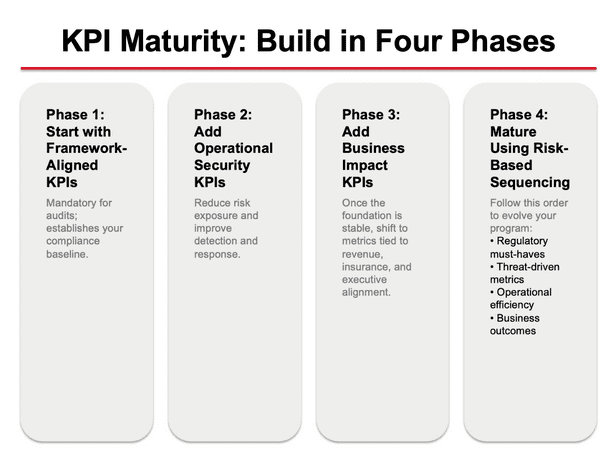
The list of potential KPIs you can choose is long and, honestly, a little daunting. Fortunately, you don’t have to implement all of them at once. A strong compliance program uses a phased, risk-based approach such as the one in the diagram below.
How your CaaS partner makes KPIs achievable
Establishing KPIs is one thing; keeping them accurate is another. When it comes to creating meaningful reporting, many organizations struggle with data sets, dashboards, and logistics. Evidence can be scattered across several systems and producing noisy data. Policies can change faster than documentation. And teams are often overloaded with audit cycles and other service fire drills. This is where an MSP can shine, helping overcome problems with more automated reporting systems.
A governance-forward MSP should be able to help you realize a mature CaaS program, delivering outcomes such as these:
- Daily compliance leadership, including guidance n KPI setting, monitoring, and corrective action.
- Centralized automated evidence collection, so there’s no more scrambling before audits.
- Proactive policy and risk management, so policies stay current, evidence stays accurate, and any regulatory mismatch issues are caught early.
- Operational discipline across security controls, so patching, vulnerability management, access control, and disaster recovery testing are handled systematically.
- Executive-ready reporting, so dashboards, evidence packs, and board reports improve visibility and trust.
- Clear responsibility models, so ownership is defined, reducing confusion, mission overlap, and missed tasks.
The right CaaS partner shouldn’t just track performance indicators; it should make them work for you and your organization. Don’t accept anything less.
Are you ready to find a CaaS provider for your company?
Strong key performance indicators give organizations a measurable and repeatable way to strengthen compliance and reduce risk. When they’re tied to the right frameworks continuously trapped, and aligned with business outcomes, they truly can become a powerful tool for your company’s growth.
A strong MSP can help turn KPIs from static measurements into an operational system that streamlines audits, matures security posture, and sets your organization on track for growth.
If you’re ready to find a compliance as a service provider, Integris would love to help. Contact us today for a free consultation.