The newest bank email scams coming in 2026, and how IT leaders can defend against them
AI-powered phishing has changed the tempo and tactics of fraud. Now banks are the primary target. Here's how to harden your institution's defenses against their latest tricks.
Key takeaways:
- AI-powered phishing is driving more sophisticated, convincing attacks, making banks the top global target for email fraud.
- Business email compromise (BEC) and deep-fake enabled scams are causing record financial losses, with wire transfers and executive impersonation as primary attack vectors.
- Banks can blunt these threats by enforcing strict e-mail authentication, adopting smart friction processes for payments, and training staff to recognize deep fake tactics.
Why 2026 is a tipping point for bank email scams
Bank email scams used to be difficult to pull off, requiring advanced programming knowledge to write worms or ransomware, sophisticated understanding of social engineering techniques, and even graphic design skills. But not anymore.
With inexpensive generative AI, now anyone can generate polished, brand-accurate lures, clone executive voices, and even stage deep fake video meetings that rush staff into moving money. In financial services, where speed, trust, and irrevocable payments converge, the stakes have never been higher. How bad is it?
Consider these recent statistics:
- Banks and financial institute solutions now account for more than half of all global phishing attacks, according to recent reporting from the American Bankers Association. In spite of this, only 42% of the 510 largest U.S. banks enforce strong policies to reject and quarantine unauthenticated emails.
- The financial services sector loses more money from cyberattacks than other businesses. According to the latest data breach reports from IBM, financial services institutions lose $6.08 million for each breach, compared to the national average of $4.88 million.
- Losses are getting more difficult to recoup. According to the 2025 Payments Fraud and Control survey from The Association of Financial Professionals, only 22% of organizations were able to recover 75% or more of the funds that they lost due to payment fraud—down from 41% the previous year. How did hackers get away with it? Better executed, more believable versions of third-party vendor impersonation were up, experienced by 63% of respondents, while wire transfers reclaimed the top spot as the most vulnerable payment type targeted by business email compromise.
- Email compromise is still the budget breaker. According to Fortra’s BEC Global Insights Report, the company’s active defense telemetry in 2025 saw wire request BEC amounts averaging $24,600 and a 61% rise in wire focused attacks —an indicator of steady monetization pressure from malicious hackers.
While customer service is being delivered on many devices, bank email scams are your institution’s greatest threat. Let’s get into the bank email scam lures you can expect to see at your bank in 2026.
How bank email scams will evolve in 2026
No. 1: Executive and vendor impersonation, now with deepfakes
Attackers can now create very convincing deep fakes, both in static emails, and in live real time video and voice. This has been getting a lot of publicity lately, and for good reason. Perhaps the most famous example is what happened to a Hong Kong based finance employee who wired $25.6 million to a combination of 15 offshore accounts, believing he’d gotten a live video call verification to do so. In reality, scammers sent a request via e-mail pretending to be company executives requesting money for the completion of an acquisition.
When the employee demanded in person verification, they sent a meeting request through the company system. He then got on a video call where every member of the company’s board was present at an “off-site meeting”—only every member of the board was a live deep fake. The organization still hasn’t recovered their money, and the hackers haven’t been found.
A cottage industry supporting these kind of deep fakes is growing on the dark web, with scammers and professional actors offering their services to create the tech and talent behind these dangerous attacks.
What to do about BEC-driven deep fakes:
- Whenever possible, require enhanced verifications for large wire transfers. Require in person verification by calling the recipient back at a phone number that can be independently verified. The requester should be required to display two pieces of identification and/or answer challenge questions with predetermined code words.
- Assume all voice and video requests could be fraudulent, especially if they involve the transfer of large sums of money, requests for highly sensitive information, or requests for money to go to a new bank account or e-mail.
No. 2: Scammers impersonating banks at scale
Some of the most dangerous email scams are the ones being sent to bank customers. Here’s how they work.
Unsuspecting bank customers receive a text or an e-mail saying the there is a problem with their bank account, and they need to click a link to fix the problem. Scammers spoof the web address link, masking the actual fraudulent site with an address that looks like it’s coming directly from your bank. When customers get to that fake site, they are directed to enter their password information and other personal details. Scammers then use that information to siphon money from their accounts, directly from their online banking account. The OCBC Bank of Singapore recently endured an extended attack using this technique, costing some customers up to $140,000 in account losses each.
What to do about bank impersonation scams:
- Post a security advisory to educate customers. Tell them that the bank will never send links or make phone calls requiring them to transfer money or give out personal details. Instruct them to instead to log out of their email or hang up the phone, then log in separately to their bank online account, or call the bank directly to verify their accounts and report the scam attempt.
- Train staff on how to assist customers who’ve received scam calls. When customers call with questions, train your staff to aid with standardized protocols for reporting the scammers.
No. 3: Realtime push payments, realtime regret
Authorized push payment (APP) platforms like Zelle and Venmo have become a favorite tool of scammers. Your bank customers may receive emails or text messages from fraudsters tricking customers into sending money via instant payment platforms, saying your bank or even a loved one requires that you make payment for a bill. Once the money is sent, it’s often impossible to recover.
Morningstar reports that of the $481 billion transferred using Zelle every year, $125 million is getting stolen from consumers. US regulators have flagged a sharp rise in fraud involving these platforms, and they’re investigating how banks handle customer disputes and losses.
Stay ahead of the problem with these interventions:
- Strengthen customer education, proactively warning customers that banks will never ask them to send money through a third-party app, or request money of any kind. Encourage customers never to click on the links sent or visit the payment channels listed, but to verify suspicious requests by contacting the bank directly using official channels.
- Implement smart friction controls that add extra verification steps for high-risk transactions, such as new payees or large transfers. Use behavioral biometrics and device history to flag suspicious payment activity.
- Enhanced payment verification by requiring callbacks for large or unusual payments. Consider kill switches and cool off periods for device or contact changes.
- Collaborate with regulators and industry groups. Participate in intelligence sharing frameworks like FSISAC’s Stop the Scams to stay informed.
No. 4: Third party and supplier risk up the ante
Banks rely on a network of suppliers and service providers for everything from IT services to payment processing. If a hacker can manage to infiltrate a supplier’s network, it could potentially work its way into the systems of all the banks that they serve. With the ability AI gives hackers to do better research and customization, it’s no wonder that the FS-ISAC (Financial Services Information Sharing and Analysis Center) highlights attacks on suppliers as a growing risk for banks.
Malicious hackers first target the vendor’s e-mail account and use it to send fraudulent invoices or payment instructions to banks. Because these emails appear to come from trusted partners, bank employees are more likely to act on them, resulting in large scale theft.
What to do about third-party vendor attacks:
- Apply strict email authentication requirements and inbound anomaly scoring to vendor domains. Incorporate these controls into third party risk management reviews.
- Test your rapid recall protocols. Validate the protocols you use to “claw back” funds when improper transfers are made by testing them in practice. Ensure that staff know who to contact, what forms to submit, and how to escalate cases quickly. This can be especially important if the money has been transferred to the favorite hideaway of hackers, the cross-border account. Simulated event testing will help staff understand the steps, timing, and communication needed to respond quickly when the fraud involves several jurisdictions.
Five controls to prevent bank email scams
Control no. 1: Email authentication and brand protection
Domain-based Message Authentication, Reporting, & Conformance (DMARC) is an e-mail authentication protocol that protects organizations from e-mail spoofing and phishing. It works by allowing domain owners to specify how receiving mail servers should handle emails that fail authentication checks.
Banking industry best practices usually recommend DMARC with a strong “reject” policy for enforcement. With this policy in place, emails that fail authentication checks are blocked before it ever reaches the recipient’s inbox or spam folder. This provides strong protection against unauthorized senders and impersonation attacks.
Control no. 2: Payment verification redesign to slow high-risk transactions
High-risk payment corridors, such as those involving UK or Hong Kong intermediaries, are often exploited in BEC scams. To counter this, banks should require callbacks to verify out-of-band transactions preferably made through a separate communications channel like a phone call rather than an e-mail. Additionally, placing holds on payments to new beneficiaries gives banks time to review and flag suspicious transactions before funds are released. For more guidance, visit the FBI IC3 guidance on payment fraud.
Control no. 3: Comprehensive training upgrades to reflect new security realities
Banks must move beyond generic training modules and run realistic deepfake drills for finance, treasury, call center, and branch leadership teams. This will give your staff hands-on experience recognizing and responding to the advanced security threats of the AI era. Reality-based training fosters a culture of skepticism and verification, especially for urgent or unusual requests. With the right training, your staff can be your bank’s best defense against business email compromise and transfer fraud.
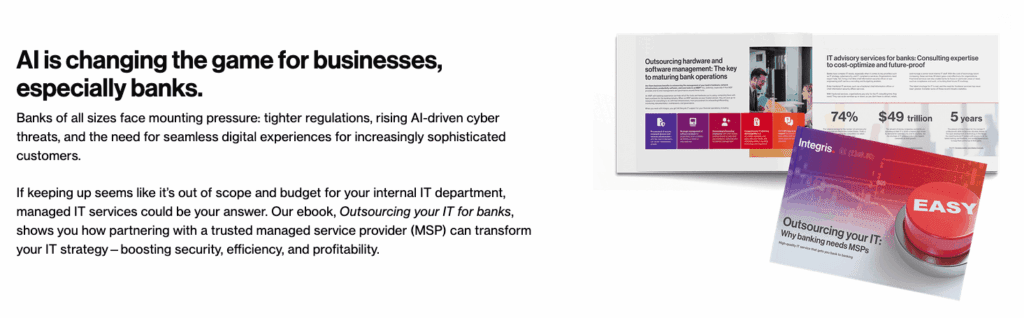
CTA: Outsourcing your IT for banks eBook
Control no. 4: Vendor and third-party email security that spots anomalies
Because banks are so reliant on their vendor partners, they should be required to use strong e-mail authentication (such as DMARC) and inbound anomaly scoring to detect suspicious emails from vendor domains. These controls should be incorporated into third-party risk management reviews to ensure ongoing vigilance.
In general, email anomalies might include:
- Messages sent from domains that resemble but are not identical to the bank’s own domain (such as bankofamericausa.com instead of bankofamerica.com).
- Messages sent from new or rarely used external domains not previously seen vendor correspondence
- Emails containing suspicious links, especially those using URL shorteners
- Attachments with uncommon file types (such as exe., .js, .scr) or those that are password protected.
- Unusual language patterns or requests for urgent wire transfers, changes to payment instructions, or requests for sensitive information.
- Emails with malformed headers, missing reply-to addresses, or spoofed sender information
- Transactions that exceed regulatory thresholds or violate anti-money laundering (AML) rules
- Any activity that deviates from a user’s typical behavior, such as sending large volumes of emails or accessing unfamiliar systems.
Control no. 5: Consumer-facing friction
While most consumer requests for transfers generally come from within their desktop or phone banking apps, it’s important to introduce friction into the banking environment, even when the request comes through email.
In general, it’s good to require additional verification such as multifactor authentication, biometric checks, or one-time passcodes for large transfers, the addition of new payees, or transactions from new devices or locations. When making unusually large first-time payments to new beneficiaries, some banks insert a six-hour hold on large transfers, during which time customers receive alerts and education about potential scams. AI monitoring tools can now provide behavioral biometrics to analyze transaction patterns, device history, and user behavior in real time. Customers are contacted directly for more verification to ensure their identity and transaction intent.
Kill switches can also be a useful fraud deterrent. This tool allows customers to quickly freeze or cancel transactions or accounts if they suspect them to be fraudulent.
If you’d like to upgrade your defense against banking email scams, Integris can help
For IT leaders in financial services, bank e-mail scams in 2026 won’t be more of the same. They’re faster, more convincing, and closer to the payment rails. Fortunately, Integris can help. We are an MSP partner to more than 100 banks across the United States, with the dedicated banking IT division staffed with CISSP-certified fractional CISOs who can help you implement the industry’s best email security strategies. Contact us today for a free consultation.