How to turn AI adoption into measurable business value
AI tools create possibilities. Connected data, practical support and clear ownership help your people turn them into business results.

Buying AI tools is the easy part. The value comes when your people have the right data, know how to use the tools and have somewhere to go when they get stuck.
Someone in your business finishes a customer meeting. They’ve got the transcript, but they still have to write the follow-up email, update the CRM and assign the tasks. Someone else is pulling information out of three systems to build the same report every week. A department head knows a process is annoyingly manual and has a pretty good idea of how to fix it. So where do they go with that idea?
These are business problems your people already understand. AI gives us more ways to solve them. But giving someone a license doesn’t get the workflow built or the data connected. You’ve still got to help them get it over the line.
That’s what Kyle Wewe and I discussed in Fresh Brew, recorded in Tucson after the 2026 Integris Customer Summit. If AI is changing what your team can do, then we’ve got to change how we help them do it. That has real implications for the role of your managed IT provider.
Buying AI licenses is only the beginning
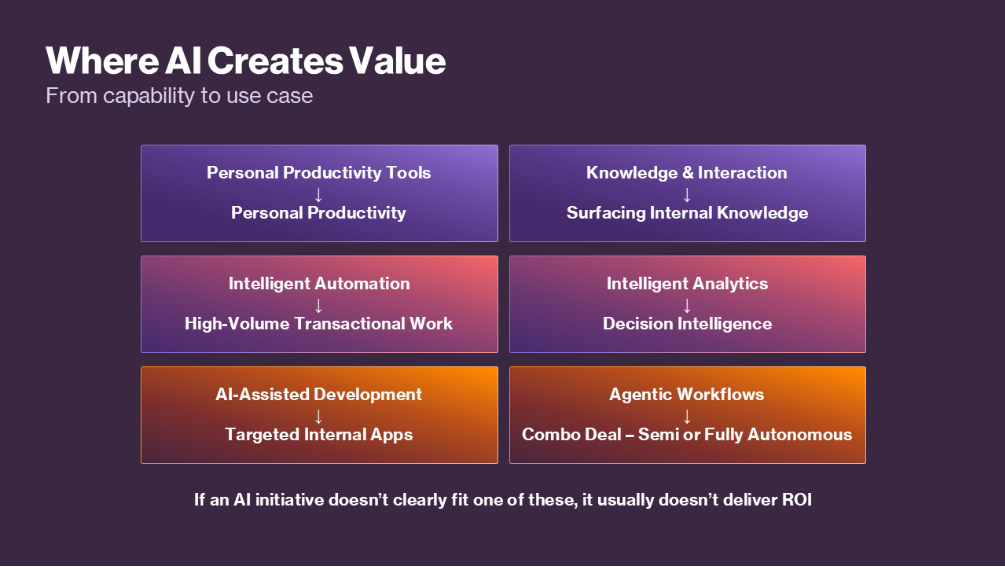
For most businesses, the starting point is personal productivity. You’ve got ChatGPT or Copilot, and you ask it to improve an email, summarize a document or help you prepare for a meeting. That’s useful, and you can get started without connecting it to much else.
Then someone goes, “Okay, can it find the answer in our internal knowledge? Can it tell me what’s happening across our business systems? Could we use it to build an application or automate this process?” That’s where the opportunity gets much bigger.
It’s also where there’s more work to do. What data does it need? Who should have access to that data, and who definitely shouldn’t? Which ideas are worth pursuing first? Your people need answers to those questions and someone who can help them make it happen.
Giving people some licenses isn’t an AI strategy. You’ve bought a capable tool. Now you’ve got to work out how your business is going to get a return from it.
Good ideas get stuck between departments
Your department heads and the people doing the work know the problems to solve. They know which processes are annoyingly manual. They know where customers are waiting and how they could add more value. Often, they’ve already got an idea of what needs to change.
The problem is that getting it done can involve half the business. IT owns the systems, the department owns the process and somebody else controls access to the data. The person with the idea is left trying to pull all of that together while still doing their job.
So either the idea goes nowhere, or someone finds a way around it. They export a report, put it into a chatbot and start working from a separate copy. That might get them through today’s task, but who’s looking after access? Who’s keeping that data current? Who maintains the workflow when something changes?
That’s why we believe AI has to sit within the managed service model. It touches your data, your security, your business systems and your people. You can’t manage it properly as a disconnected extra.
CORE changes how the business gets help
CORE Intelligent Managed Services brings those capabilities together. You’ve got the support and security your business already relies on, with data governance, AI enablement, training, automation and strategic guidance as part of that relationship.
The aim is pretty straightforward. When someone has a business problem, they should have a way to get help solving it. That means the right tools, secure access to the right information and a clear view of whether the improvement is actually worth doing.
You should hear the difference in the conversations you’re having with us. Your team can bring an idea to the help desk. Your advisor helps work out which initiatives to pursue. And training carries on as people use the tools in their roles, because the questions don’t stop after onboarding.
The help desk has a new job
The help desk still has to get your laptop working and get you back into the application. Of course it does. But with AI, there’s a much bigger role for it: helping your people get more value from the technology they’ve already got.
So the call becomes, “I’ve got an idea. How do I automate this workflow?” Or, “Can I create an assistant that makes our internal knowledge easier to find?” Your team should have somewhere to take those questions and get practical help using the company’s approved AI tool.
We had a client who was finishing meetings with a transcript and then doing all the follow-up manually. They now have a workflow that summarizes the meeting, sends the email and creates the tasks in their CRM. That’s useful because it takes work off someone’s plate every time they finish a meeting.
Sometimes we’ll help build the workflow. Other times, we’ll show someone how to do it themselves. That second part can go a long way. Once someone understands how to solve one of these problems, they start seeing other things they can do.
So here’s the question I’d ask: when someone in your team has an idea, or gets stuck trying to make it work, do they know who to call?
The account advisor has a new job too
You can sit down with your provider and hear how many tickets they closed last month, how long they took and which devices are coming out of warranty. That’s useful information. But the conversation also needs to look ahead. What are we doing next month to help your business be more productive or increase revenue?
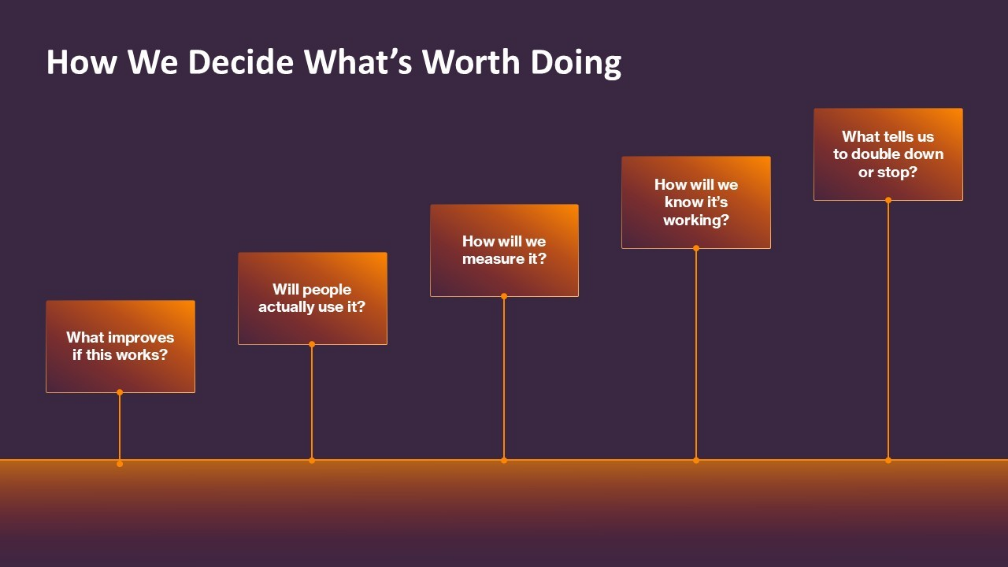
That’s the job of the strategic account advisor. Start with the business. Where are you losing time? What’s getting in the way of growth? Where could the customer experience be better? Then work back from there to an initiative, someone responsible for it and a clear idea of the return you expect.
If we’re trying to speed up a process, let’s measure how long it takes. If we’re creating capacity, what will the business do with that capacity? Saving people time is useful, but we’ve got to understand where the benefit shows up in the business. Can you take on more work? Deliver a better service? What’s the return?
Then, every month, you can ask, “Did we see what we thought we’d see? Do we put more effort into this one, change it, or move on to the next initiative?” That’s a much more useful conversation about your investment in technology.
There is no return without adoption
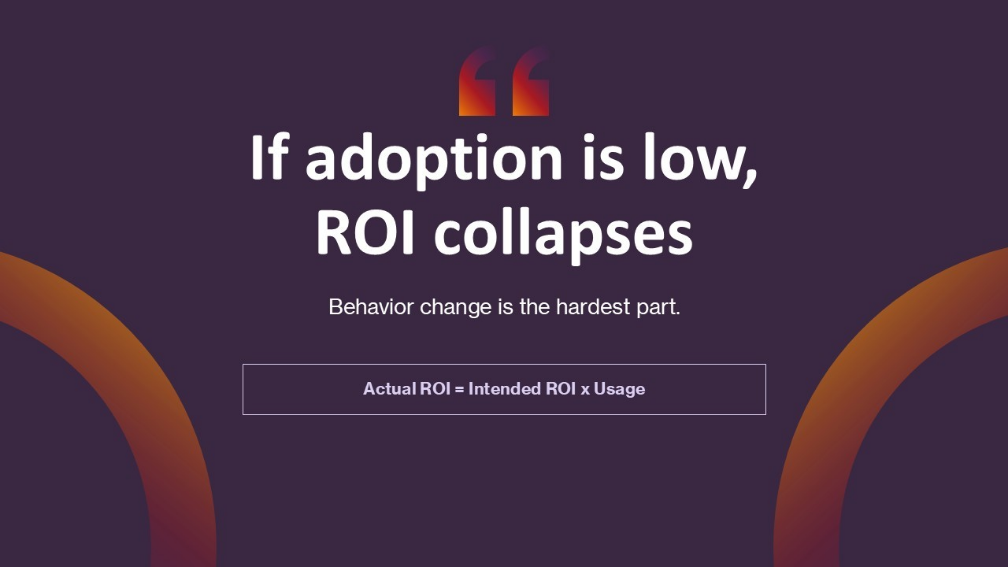
You can build something that works perfectly and still get very little value from it. If the people it’s meant for aren’t using it, the business doesn’t get the return. It’s as simple as that.
So adoption has to be part of the work from the start. Give people access to the approved tools, show them how to use them in their roles and make sure they’ve got help when they get stuck. Then keep doing it. New people join, the tools become capable of more and the way your business uses them changes.
You’ve also got to look at what people are actually doing. Who’s using the new process? Where are they stopping? Is something confusing or taking too much effort? Those answers tell you what to fix. Another demonstration of what AI could do won’t answer those questions for you.
The data has to be ready for the work
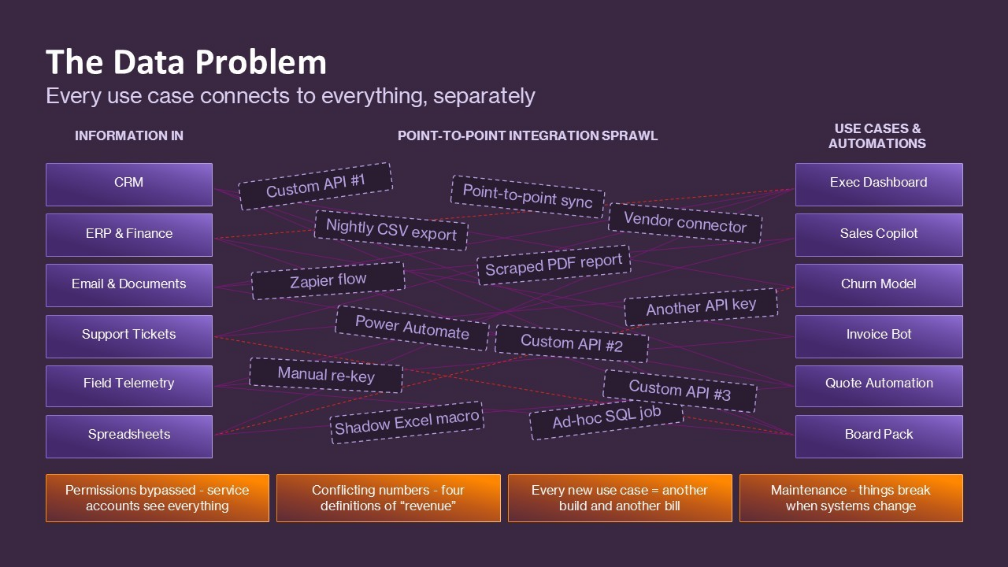
Once you move beyond personal productivity, the data becomes a big part of the job. You can pull a report out of your CRM and put it into a chatbot, but what else does it need to know? Is that report current? How are you controlling access to the information?
Connecting each person to each system separately creates a lot of overhead too. This person needs access to one set of information and definitely shouldn’t see another. Someone has to maintain all of that, and make sense of the data coming from different systems. It gets difficult to scale.
How CORE Intelligence connects the data
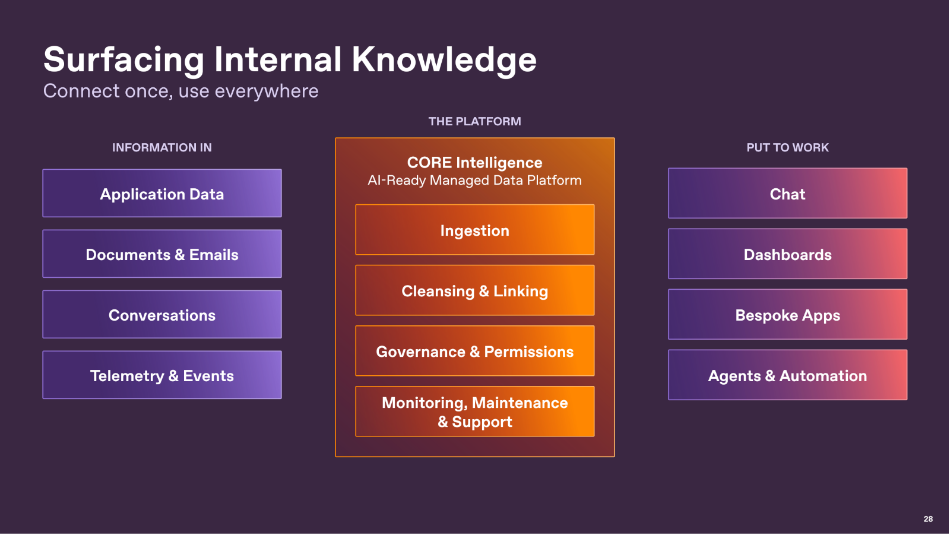
That’s where CORE Intelligence comes in. It gives you a shared, managed data foundation. We bring the relevant information together, cleanse it, link it and put the governance and permissions around it. So when you add another AI use, you’re building on that work instead of starting the data preparation and access setup again for every person and tool.
That can support chat, dashboards, custom applications and automation. You’ve still got to be clear about what you’re building, who needs access and what’s included in the work. The connections and data views also need monitoring, maintenance and support as your business changes.
Because none of this stays the same. You add a system, someone changes roles or a new version of a document appears. Keeping the data ready for AI is an ongoing job, and somebody needs to own it.
What this looks like in real businesses
Australasian Retail Projects made knowledge easier to use
One of my favorite examples is Australasian Retail Projects, which fits out retail spaces. They had an employee whose knowledge was central to how the business worked. There were great spreadsheets and planning documents, but knowing how to use all of that still depended heavily on her. That becomes a real problem when you want to grow, or when that person takes time off.
After they came onto CORE, she called our help desk and asked for help using Claude. We showed her an example workflow, and she took it from there, automating more of her own work. What I liked about the result was that her knowledge became available beyond her own involvement. The business was less dependent on her being there to keep things moving.
She already knew the business and the problem. What she needed was someone to show her how to get started. Once she had that, she could do a lot herself. That’s why making practical help available matters so much.
Shamrock connected faster work with a commercial result
Shamrock is another example I like because the business problem was so clear. They needed to get products to market quickly, but the design process and communication with suppliers were too manual and too slow. They used AI and information they already had to rethink that work, including how to deal with suppliers without relying on the person who’d worked with them before.
Their chief operating officer told me that a customer relationship that had been losing money had become profitable. That’s the outcome they reported back to us.
So you’ve got a clear connection there. The business was moving too slowly, they changed the processes holding it up and they could point to a commercial result. That’s the sort of conversation we want to have about AI.
Start with the next problem worth solving
Start with a business problem your people already know needs solving. Who owns it? What would a better result look like? What data do you need, and can the right people access it securely? Then get the people who understand that process in the room and give them the support to make the improvement happen.
From there, look at use and results together. If nobody’s using it, find out why. If it’s working, decide whether there’s more value to get from it. And be prepared to say, “We were wrong. That didn’t work.” Every initiative starts with an expectation. You’ve got to check whether it holds up.
That’s what we’re doing with CORE. The help desk has a bigger job. The advisor is asking different questions. And your team has somewhere to go with the ideas that could make your business work better.
Talk to your Integris advisor about a process your team wants to improve. Let’s start with what you want to achieve, work back from there and agree how we’ll know it’s made a difference.
About the author

Brendan Ritchie is SVP of Marketing at Integris.