Deploying secure AI and displacing shadow AI are key to mitigating business risk
A key business risk today is shadow AI, which easily jeopardizes sensitive business data. But you can secure AI with tools like Integris Secure Chat and Managed AI Workspace.

Key takeaways on shadow AI and secure AI:
- AI adoption is widespread, but “shadow AI” use is high—creating major security, compliance, and data leakage risks.
- Many smaller and midmarket firms lack AI policies, increasing exposure as employees use unapproved tools with sensitive data.
- Secure AI environments, policies, and training are essential to balance productivity gains with data protection.
Today’s organizations are clamoring to reach the next phase of digital maturity—and they are adopting AI tools to get there.
According to McKinsey & Co., some 88% of organizations are using artificial intelligence in at least one business function. At the same time, data indicates that 59% of workers say they use AI tools that have not been approved by their company. Unapproved tools often pose security and governance risks. Known as shadow AI, this problem emerges when organizations and employees cut and paste sensitive business data into open AI platforms–jeopardizing that data by exposing it to open models.
Shadow AI can afflict midsize organizations disproportionately, according to data.
Smaller companies had about 200 shadow AI tools per 1,000 users, which amounts to “enormous per capita exposure.” Moreover, smaller organizations are often the ones “winging it” on AI adoption without the secure platforms and best practices to make AI adoption successful. And some 77% of small businesses using AI have no written AI policy.
Fifty-nine percent of respondents to a recent survey
Cybernews
say they use AI tools that aren’t approved by their company
Why shadow AI is a business risk
Shadow AI jeopardizes sensitive customer and business information as well as intellectual property (IP). When employees copy and paste sensitive or proprietary information into public AI tools to get rapid results, they expose proprietary and sensitive business data to these models.
Once this information is input to public AI tools, that data may be saved in AI models, then used for model retraining. The data is no longer protected or proprietary, but now is potentially part of models’ future output.
That issue emerged dramatically in the case United States v. Heppner. The case established that information that documents generated by AI are not protected by attorney-client privilege, even if used for legal strategy. And the case also ruled that sharing confidential information with an AI chatbot constitutes a waiver of attorney-client privilege.
As organizations and individuals adopt artificial intelligence, shadow AI isn’t just a nuisance. It’s a serious business risk. In 2023, for example, Samsung engineers exposed proprietary code and confidential meeting notes by submitting them to ChatGPT. As a result of the data being copied into the AI tool, it was no longer within the company’s control.
And a midsize company recognized its problem with shadow AI as employees got accustomed to copying sensitive information into ChatGPT, such as a customer configuration file. While there was no data breach event, it exposed vulnerability in the company’s process, and the organization moved to change workflow processes to prevent sensitive data leakage.
“Shadow AI presents a whole new level of risk for organizations—and they don’t even realize it,” said Kris Laskarzewski, chief transformation officer at Integris. “Without a secure AI environment at their fingertips, workers will turn to platforms that seem to make their work easier but instead create serious data and compliance risks.”
Why you need secure AI tools
But organizations don’t have to sit still for AI data risks. They can deploy secure AI tools that empower their employees to work with secure, reliable answers to their questions without jeopardizing IP or sensitive data.
With a secure, closed AI environment, workers can get access to a ChatGPT-like AI agent for answers without risk. They can also work closely with MSP partners to develop best practices, education plans, and training for their workforce to empower employees.
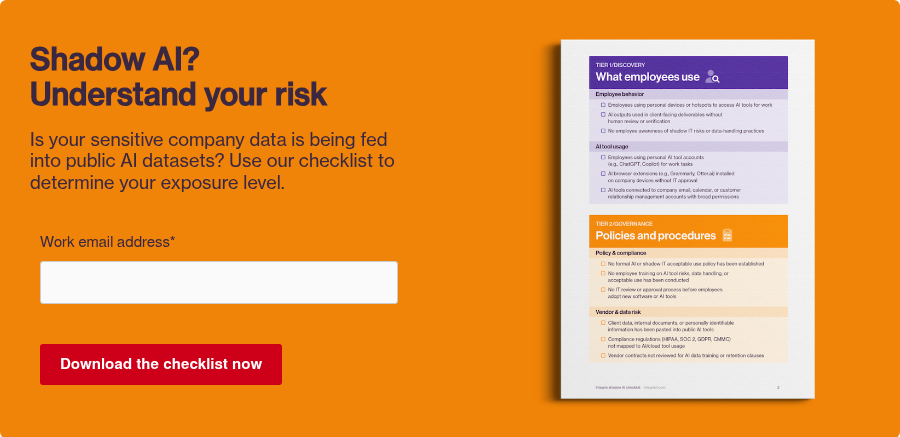
Further, teams can get tools and training on best practices for secure AI use. AI acceptable use policies, training, and a secure AI checklist give workforces the guardrails to use AI responsibly and securely while still promoting efficiency and productivity.
Integris, a managed service provider with a proven track record in data security and governance, has released two services that address the need for secure AI tools. These services empower organizations and their workforces to adopt AI tools securely and responsibly to get the most out of AI environments.
Integris releases Managed AI Workspace, Secure Chat
Integris has released two services to address shadow AI and introduce secure AI tools to empower workforces.
Integris Managed AI Workspace. Managed AI Workspace includes Integris Secure Chat. This closed AI environment is your organization’s answer to shadow AI, providing a secure, reliable AI environment for your workforce.
- Secure private AI chat. With Integris Secure Chat, organizations get access to multiple leading AI models including GPT, Claude, and Gemini through a single secure interface. Importantly, no sensitive data is sent to public models.
- Visibility and controls. Integris monitors AI chat adoption, usage patterns, and security posture. As a result, your AI environment gets the same oversight as the rest of your managed infrastructure.
- Office hours. Even with training, employees have questions about AI use. Spend time with Integris experts to answer key questions, troubleshoot, and mine value from the platform over time.
- Governance and policy. Teams get an AI acceptable use policy that outlines clear guardrails on responsible use as well as best practices to use AI securely and optimally.
Ultimately, Managed AI Workspace enables your organization to use AI for productivity and innovation without sacrificing data security. With a secure AI environment, teams can reduce the time it takes to complete tasks from hours to minutes and do more without adding headcount.
If your organization wants to move forward with AI adoption safely, don’t get left behind. While public AI tools are risky, the answer isn’t banning AI; find a secure, compliant AI environment that suits your business.
Want to learn more about Integris AI services and Managed AI Workspace?
About the author

As director of content marketing at Integris, Lauren Horwitz brings more than a decade and a half of experience in digital publishing and editorial leadership. She specializes in content strategy and development to reach key audiences. Horwitz has held senior roles at HUMAN Security, Dynatrace, Informa Tech, Cisco.com, and TechTarget.