Seven AI business opportunities that already show ROI
Despite massive investment in AI, many organizations often struggle to demonstrate return on investment. Here are seven AI business opportunities that can help you get meaningful ROI for your IT budget.

Key takeaways from this article on AI business opportunities and ROI:
- AI investment is surging, but 80% of organizations still struggle to achieve measurable ROI because success depends more on execution than technology alone.
- Proven AI use cases such as fraud detection, churn reduction, and supply chain optimization are already delivering measurable savings, revenue growth, and efficiency gains.
- Managed service providers (MSPs) help organizations operationalize AI with governance, secure infrastructure, clean data, monitoring, and integration that turn pilots into business outcomes.
It’s hard to refute that company investment in AI has grown substantially over the past couple of years.
Indeed, total AI market size is projected to reach approximately $347 billion in 2026 (up from $208 billion in 2023); this represents a 67% increase. Companies see AI business opportunities in myriad organizational functions—from sales and customer service to predictive maintenance and financial fraud detection.
Still, despite many dollars invested, organizations are struggling to achieve measurable, meaningful ROI with AI deployments. The report “Beyond the Hype: Unlocking Value from the AI Revolution,” noted that while 80% of organizations have adopted a new generation of AI, the same percentage—80%—haven’t gotten return on that adoption yet.
So let’s explore some of the key AI use cases that have already shown promise and measurable results. A majority of executives to a McKinsey & Co. survey, with companies that have adopted AI, reported that AI has increased revenue in the business areas where it is used, and 44% say AI has reduced costs (see Figure 1).
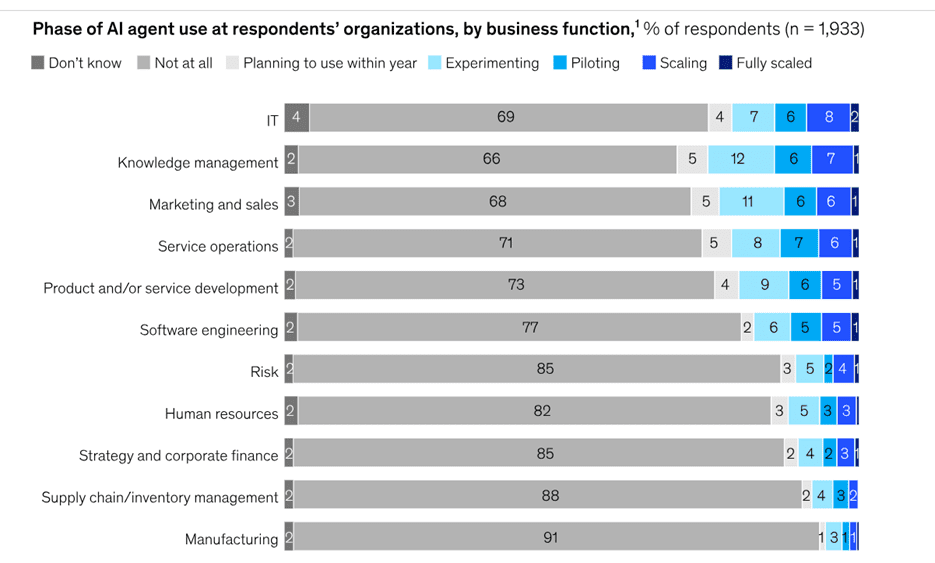
Figure 1: Organizational functions where AI is having impact, with IT, marketing and sales ranking high, and traditional manufacturing ranking lower. Source: “The State of AI in 2025,” McKinsey & Co., 2025
“AI is no longer about experiments, but about showing measurable performance outcomes,” said Julie Sweet, Accenture CEO, in a Times of India article. And indeed, 63% of respondents to a McKinsey survey say that revenue has increased with AI adoption.
Why MSPs can drive AI business opportunities
Return on investment in AI is determined by technologies alone. It’s largely determined by execution, and this is where MSPs come in.
While many organizations are struggling to extract measurable return on investment from AI, there are many areas of business where measurable outcomes are already possible. Supply chain optimization, customer churn reduction, fraud detection, incident prediction, and cloud cost optimization all share one common trait: These outcomes are tied to specific metrics such as reduced downtime and costs, increased revenue, and improved customer retention.
But AI success isn’t just about identifying the right outcomes and metrics to track. It requires strong IT foundations that can support these outcomes, such as clean and integrated data, well-managed infrastructure, continuous monitoring, and the ability to translate technical insights into operational improvements and successful execution. This is where managed service providers (MSPs) can play a critical role.
Seven AI business opportunities that are yielding ROI
So let’s explore how key AI business outcomes—and some of their associated AI metrics—are moving the needle for organizations. We also outline how managed service providers may be the right partner to bring realistic AI outcomes to life,
1. Secure AI. Organizations and employees are using open AI platforms regularly, sometimes cutting and pasting sensitive business information into these platforms. That exposes sensitive data to leakage as they are fed into public AI models. According to data, some 90% of organizations are using AI without formal governance.
Secure AI provides a locked-down environment that protects business information without hindering users from getting answers. One global fintech company adopted secure chat and experienced several benefits. First, customer queries moved from an average of 11 minutes of duration to less than 2 minutes. It also experienced a 40% cost reduction.
2. Financial services data and document analysis. One major financial services company was buried in legal contract analysis. Contracts sometimes sat idle, errors fell through the cracks, and deals weren’t closing. Then the company turned to nonpublic-facing AI systems to analyze legal agreements, reviewing terms, checking clauses, and ensuring compliance. Using private AI systems for contract document review ultimately saved 360,000 hours and an estimated $144 million in labor.
3. Supply chain optimization. With AI, retailers and manufacturers can improve planning, forecasting, and movement of products throughout the supply chain. Traditional supply chain planning has often relied on manual forecasting. These estimates can fall short in adapting to sudden changes in geopolitics, weather, and pricing, which in turn can have a downstream impact on customer demand.
AI systems analyze large data sets—including sales trends, weather patterns, logistics data, supplier performance, and real-time inventory levels—to generate dynamic demand forecasts and optimized distribution strategies. These systems can automatically adjust inventory levels, recommend alternative suppliers, or reroute shipments when disruptions occur.
One national retailer saved $75 million using AI to optimize its logistics and product inventory. It also achieved a 30% reduction in out-of-stock inventory and a 20% reduction in overstock inventory costs.
4. Customer churn reduction. Customer churn—the rate at which customers stop doing business with a company—can easily become kryptonite for a company, reducing revenue and undercutting reputation. But organizations struggle to understand how to predict and prevent churn. AI has helped some companies see the early signals for customer churn.
One bank deployed an AI-powered customer churn prediction and prevention system aimed at identifying customers at risk of leaving and improving retention strategies. The goal was to reduce churn rates and increase the lifetime value of customers. By identifying at-risk customers early and personalizing customer retention strategies, the bank reduced churn by 30%.
Integris has also used AI to address customer churn. The managed service provider has input various potential triggers into an AI model, such as contract renewal dates, customer sentiment data, CSAT (customer satisfaction) scores, and sales data. By combining these data points into a “churn score,” Integris can intervene to proactively reduce churn and boost client satisfaction.
While the Integris churn prevention program is relatively new, many companies are seeing real long-term results. According to one estimate, a reliable AI-generated churn prediction score can flag unhappy customers long before they leave, and reduce customer departure churn by as much as 15% to 25%.
5. Financial fraud detection. Traditional rule-based systems rely on static thresholds, such as flagging transactions above a certain dollar amount or from unusual geographic locations, for example. However, AI models learn from signals in real time. As a result, AI can offer a faster but more nuanced approach to detecting anomalies.
AI-enabled systems can analyze billions of transactions and flag spurious user behavior patterns, device signals, and more to identify subtle anomalies that indicate potential fraud. One financial institution used an AI-enabled platform to identify fraud in credit card transactions, which resulted in a 64% reduction in fraud and a 42% decrease in false positives.
By analyzing transaction data, user behavior, and anomalies in real time, banks can stop fraudulent transactions before they happen. At the same time, they can boost customer experience and prevent false positives (or real transactions falsely flagged as fraud).
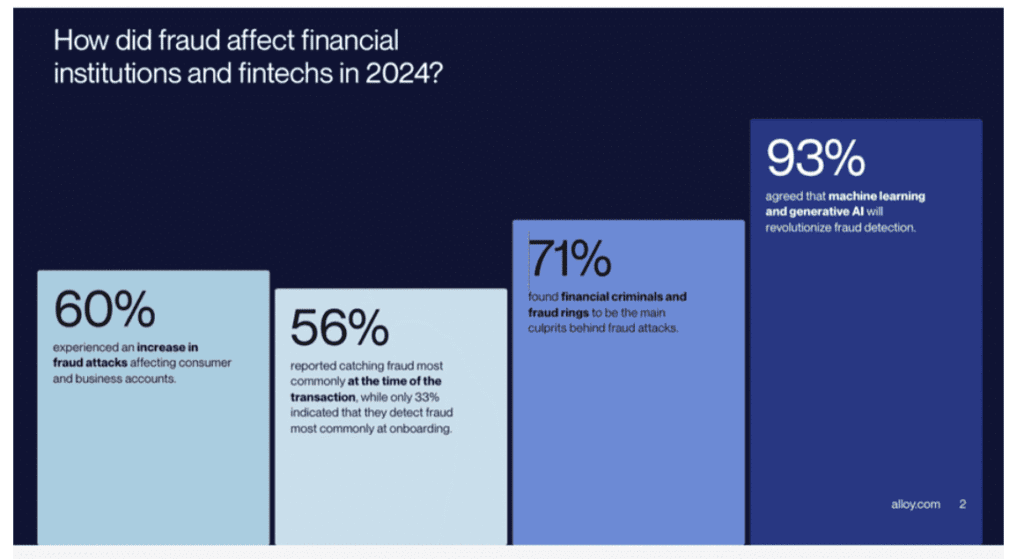
Figure 2: Financial fraud is a significant issue for financial institutions, with 60% experiencing a fraud attack. Source: Alloy, “2025 State of Fraud Report.”
6. Incident prediction and prevention. Incident prediction and prevention measures how effectively AI systems can preemptively identify and remediate potential infrastructure or application failures. Instead of relying on reactive alerts after an equipment or system outage occurs, AI models analyze telemetry data such as logs, performance metrics, network flows, and system events to detect patterns that historically precede failures. When a system identifies these signals early, IT teams or automated workflows can take corrective action—such as reallocating resources, restarting services, or patching vulnerabilities—before users experience an incident.
One midwestern specialty steel manufacturer used an analytics platform to move from a reactive fire-fighter in the face of downtime and equipment failure to a proactive organization that is ahead. Before using a predictive analytics platform, unexpected equipment failures were affecting the manufacturer’s ability to meet customer delivery commitments and maintain profitability, with critical machinery failing every 45-60 days on average.
The steel manufacturer selected an analytics platform capable of Internet of Things (IoT) integration and real-time monitoring. With an analytics platform, the manufacturer achieved a 30% reduction in unplanned downtime and $850,000 in annual operational savings.
7. Cloud cost reduction. When organizations use AI-powered cloud cost reduction, it can reduce cloud waste by 20%–30%. A company can accomplish this by identifying inefficient resource usage, anomaly detection, and prioritization of optimization actions.
Often known as FinOps (or financial operations), organizations can reduce skyrocketing cloud costs through an automated analysis of IT environments with these kinds of actions:
- Automated rightsizing of compute resources
- Detection of unused workloads and storage
- Prioritization of high-ROI cost optimizations
- Predictive cost forecasting
One U.S. regional bank, for example, implemented FinOps, saving $3 million, and enabling the bank to reallocate its cost savings to other IT initiatives, such as investments in deposits.
How MSPs can pave the way to AI business opportunities
MSPs bring the operational expertise needed to move AI from experimentation into production. They help organizations identify the most valuable AI use cases based on their operations, data, and workflows. The right MSP understands how to integrate AI tools with existing systems, and build the data pipelines and governance frameworks required to support them and create a “digital estate.” This ensures the right decision making and outcomes. Just as importantly, MSPs continuously monitor and optimize these systems to ensure the promised outcomes materialize.
MSPs help organizations focus AI on practical, measurable business problems—turning what can often be hype and experimentation into sustained operational and financial gains.
Want to learn more about how an MSP like Integris can help with AI business outcomes? Connect with Integris on AI services today.